
Quick Facts About New Car Prices
- August’s new vehicle average transaction price was $50,089 — the first time it crested $50,000 this year.
- Automakers continue to restrain incentive spending and inventory levels remain relatively balanced, though inventory in some of the most affordable segments remains constrained.
- Prices continue to rise moderately year over year, but have stayed fairly flat throughout 2026. With the current market demonstrating ongoing restraint, waiting for prices to drop may not pay off. If you need a new car, consider adjusting your budget to fit this market.
For the first time in 2026, the average transaction price (ATP) for a new vehicle topped $50,000. Specifically, the August new-vehicle ATP was $50,089. We last saw an ATP above $50,000 in December 2025. This represented a very modest 0.5% increase from July and a 1.9% year-over-year increase. Model year 2027 vehicles continue to hit lots, but gradually. In August, 2027 models increased to 12.4% of available inventory, well behind last year’s pace. This suggests automakers are introducing new inventory at a more measured pace, and the new-vehicle market is showing increasing balance.
While this doesn’t translate to lower prices, it suggests we’ll continue to see relatively stable prices. While a new car isn’t any more affordable for the average buyer, we’re not currently looking at a landscape of sharp price increases. This means that if you need a new car right now, it’s as good a time to buy as any in this market. Careful shoppers may still find some good deals, but incentive spending in August decreased to 6.5% of ATP, down slightly from July’s 6.6%. Manufacturers are showing discipline when it comes to incentives. As more model year 2027 vehicles hit lots and dealers make room for them, there could be opportunities for shoppers to find deals on outgoing 2026 models.
Read on for expert insights into what’s driving these trends and what you need to know if you’re planning to start your search or buy a car now.
- Where New Car Prices Stand
- The State of Electric
- New Car Inventory Update
- Shop Around for the Best Offer on Your Trade-in
- What to Expect: Looking Ahead
New Car Prices Rose in August, but Didn’t Outpace Last Year’s Peak
The new-vehicle ATP in August was up 0.5% from July, and 1.9% on a year-over-year basis. Recent ATPs peaked at $50,609 in December 2025, a month when prices commonly spike due to a high mix of luxury-vehicle sales. While not quite back to that number, prices rose across all five of the highest-volume segments, and the most affordable segments saw higher-than-average increases.
Because ATP is only an average, it can be helpful to look at segment-specific ATPs to better understand prices in the segment where you are shopping:
- Midsize SUV: ATP of $50,315, up 1.6% year over year.
- Compact SUV: ATP of $37,722, up 1.1% year over year.
- Full-size Pickup Truck: ATP of $67,446, up 2.1% year over year.
- Subcompact SUV: ATP of $31,149, up 2.2% year over year.
- Compact Car: ATP of $27,997, up 2.9% year over year.
While all segments are showing increases in ATP, there were a few notable developments in segment pricing. In 2026, midsize SUVs have been the highest-volume segment, with a rich mix of options. They pushed compact SUVs down to the No. 2 position. The discontinuation of the Ford Escape, coupled with the inventory constraints affecting the Toyota RAV4, disrupted two key products and contributed to a shift in overall dynamics between segments. This shuffling can influence transaction prices.
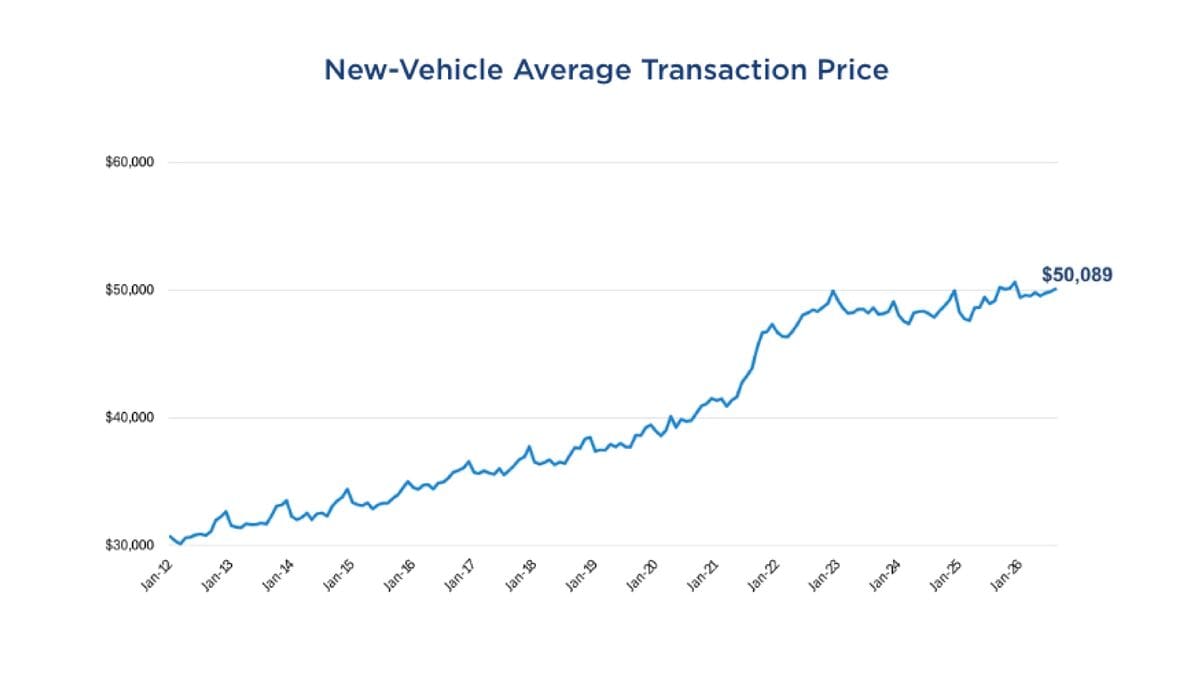
“We expected transaction prices to move back above the $50,000 mark in 2026, as new-vehicle prices typically increase through the year and especially in the second half, when next-model-year vehicles begin arriving at dealerships,” said Cox Automotive Executive Analyst Erin Keating. “New-vehicle price inflation is real, but automotive price increases have been moderate in recent years and remain below the long-term average of roughly 3%. At the same time, many American households are under significant financial pressure, which is steering more shoppers toward lower price points. The continued strong growth of subcompact SUVs highlights how important affordability remains in today’s market.” Cox Automotive is Kelley Blue Book’s parent company.
New-vehicle sales saw more movement in August, with a 3.3% increase from July, and demand remained strong. Throughout 2026, we’ve continued to see restrained incentive spending among automakers. Incentive spending declined again in August for the third consecutive month, dipping to 6.5% of ATP — its lowest point since January.
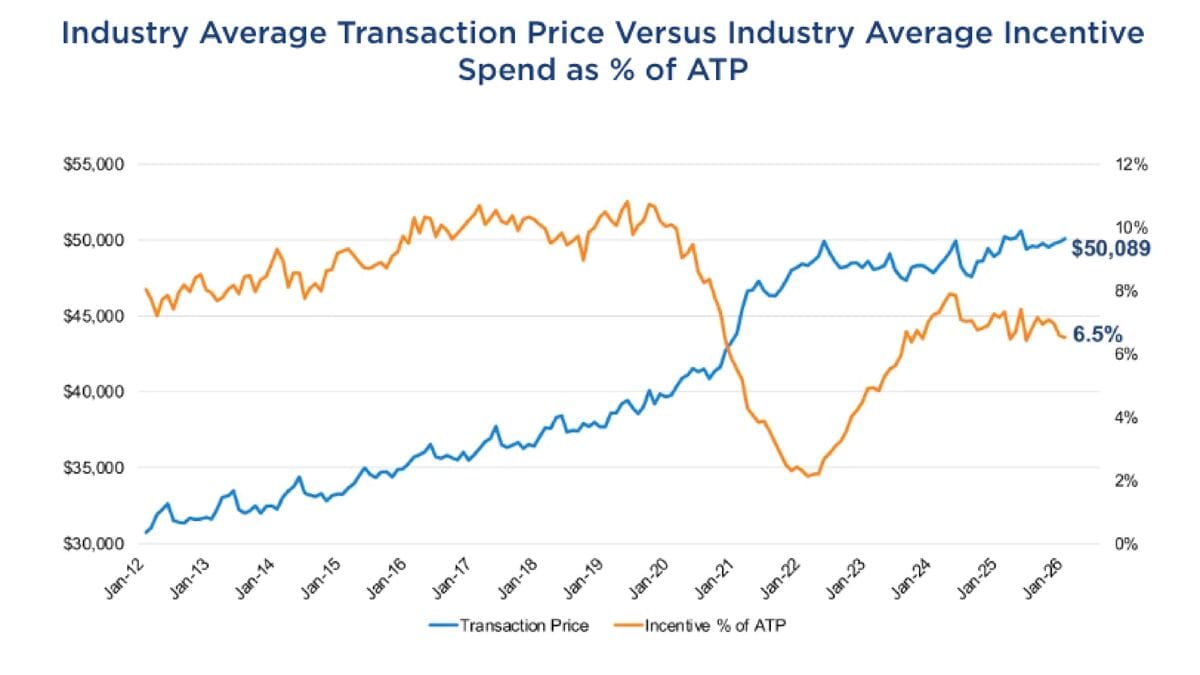
With ongoing conflict in the Middle East, fuel prices again on the upswing, and increasing economic pressure on the average household, the industry is keeping a close watch on consumer sentiment. Despite these challenges, new-vehicle demand has not suffered, and pricing has remained comparatively stable. Model year 2027 vehicles are rolling out and momentum is building, but more slowly than it did last year. This may be contributing to greater pricing stability. Inventory in the market’s most affordable segments remains tight, however.
Many buyers simply need a vehicle and cannot wait for international conflicts to end or economic conditions to improve. Explore Kelley Blue Book’s Car Affordability Information Center for curated articles designed to help you make smart, budget-friendly decisions.
MORE: Can I Afford a Car in 2026?
The Electric Landscape Sees Another Modest Boost
New electric vehicle (EV) sales saw a 2.5% month-over-month boost in August, but were down 46.9% year over year. Sales totaled an estimated 78,895 units, accounting for 5.7% of total new vehicle sales. Tesla continued to dominate, with 40,816 units sold, though this represents a 3.8% sales decline from July. Toyota, Rivian, Hyundai, and Cadillac followed. Toyota showed the largest month-over-month gains, with a 34.9% sales increase from July, led by the Toyota bZ.
The average ATP for a new EV declined to $54,754 in August, down 1.3% from July and 2.8% year over year. Incentives averaged $6,594, or 12% of ATP, down 2.2% from July and 19.9% year over year. Stronger sales of lower-priced models such as the Toyota bZ, Chevrolet Bolt, and Toyota C-HR were one factor contributing to the decline in ATP. Popular EV models, such as the Tesla Model 3, saw softer transaction prices, with the Model 3 posting a 1.9% decline in ATP from July, also contributing to the overall decline.
Inventory levels for new EVs decreased in August. Overall days’ supply fell to 78, down 9.6% from July. This decline put EV inventory at just two days above ICE+ levels — the narrowest gap we’ve seen in 2026. Inventory levels continue to vary widely by brand. Cadillac, Mercedes-Benz, and Audi saw supply rise. Subaru had the leanest days’ supply at 26 days in August. Porsche and Toyota also saw significant inventory reductions, though both remained above the industry average.
“As the impact of last year’s tax-credit-driven surge continues to fade, attention is shifting to whether recent EV market improvements can be sustained,” said Cox Automotive Director of Industry Insights Stephanie Valdez Streaty. “EV inventory levels are now closely aligned with ICE+ vehicles for the first time in months.” We’ll continue to keep an eye on the shifting dynamics in the EV market as more lower-priced models gain a larger share.
What Drives New Car Prices
New car prices are not established by any single factor. They reflect a complex interplay among the following:
- Inventory availability
- Manufacturer incentives
- Dealer discounts
- Trade-in vehicle values
- Geopolitical shifts
When any one of these factors shifts, the others may adjust to accommodate it.
New Car Inventory Update
Dealerships track the number of new vehicles they have on hand using a metric called “days’ supply,” or how long it would take them to sell out at today’s sales pace if they stopped adding new vehicles to inventory. According to Cox Automotive’s vAuto Live Market View, new car inventory data for August showed a 73-day supply, down from 77 days in July. This time last year, the figure was 75. Days’ supply in August was the lowest since April 2025. Overall supply remains sufficient to meet demand, but the most affordable market segments are seeing inventory become increasingly constrained.
Total available inventory decreased to 2.68 million units in August, down 1.6% from July’s 2.73 million and 1.8% year over year. The average listing price in August was $49,486.
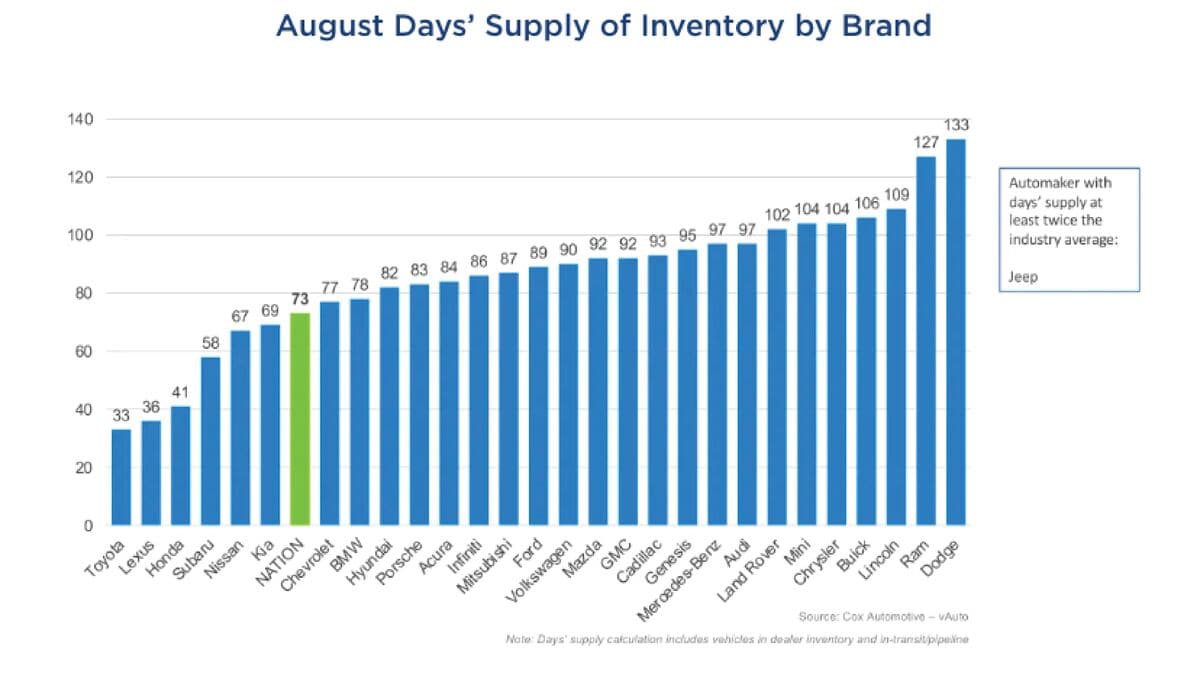
Different inventory strategies continue to show up in brand-level results. Toyota ended the month with the tightest inventory at 33 days’ supply, followed by Lexus and Honda at 36 days and 41 days, respectively. These three continue to operate with tight inventories, in somewhat stark contrast to the other end of the spectrum. We also continue to see discipline from Nissan, which reduced its days’ supply in August to 67 days, down from July’s 72 days and from near-100 levels earlier in the year. On the high end of the scale, Stellantis brands, Buick, and Lincoln, all continue to hold the most inventory in the industry.
What does this mean for car shoppers? The 2026 market has demonstrated stability. However, while inventory levels look balanced overall, the distribution is certainly not even across all brands. Prices are still ticking up each month, though slowly, and inventory is more constrained in some of the most affordable segments. Unfortunately, this creates more pressure for consumers, and deals are not plentiful. Even brands with high days’ supply continue to show restraint in incentive spending. That said, as more 2027 vehicles arrive on lots, dealers will look to make room for them. If you’re willing to shop around and consider a wider range of makes and models from prior model years, you may find a deal.
Shop Around for the Best Offer on Your Trade-in
Trade-in value is another factor driving car prices. A lack of used-vehicle stock has kept prices higher, giving credence to the idea that buying a new vehicle can sometimes be cheaper than purchasing a used model that’s only a few years old. As a result, it’s still potentially a good time to trade in your car.
Dealers value your trade-in partly based on what they need in stock, so if you have a popular model, you may be in luck. On the other hand, they may offer less or a model already plentiful on their lots. In other words, a buyer trading in a 2018 Honda Civic for something else may be much happier with the trade-in appraisal than a shopper trading in a 2021 Jeep Grand Cherokee.
Car buyers should prepare to shop around for the best trade-in offer. It requires another step, but selling your old vehicle to one dealership and buying your new car from another may make sense if the final numbers work in your favor. Use the Kelley Blue Book Instant Cash Offer tool to shop your trade-in vehicle at nearby dealerships. Comparing multiple bids makes it easier to choose the best offer. Remember, you can always negotiate the offer, and using one offer to counter another is not unheard of when shopping for a vehicle.
What to Expect: Looking Ahead
New-car inventory in August was down from July and year over year. The U.S. market had 2.68 million new vehicles available, or about 73 days’ supply. This is still a notable decline from the roughly 90 days’ supply recorded in January and February, but year-over-year inventory has been relatively stable. The industry has shown resilience in the face of rising gas prices, uncertainty surrounding the war in the Middle East, and growing economic pressure at home.
For buyers, this means that although prices aren’t skyrocketing, they continue to rise gradually. If you’ve been holding out in the hope that geopolitical uncertainty will ease, it may be time to consider that the trends seen throughout 2026 could persist. Options in the most affordable segments and among the most affordable brands remain more limited, though shoppers willing to consider different brands and models can still find incentives to help lighten the financial burden. We will continue monitoring the war’s effect on the market in the months ahead.
RELATED: Bad Credit Car Loans: Everything You Need to Know
What to Do if You Need a Car Now
Incentives are a buyer’s best friend in the current market. If you can adjust your expectations about the type of car or brand you are willing to buy, you may find good deals. Beyond that, prices remain on a steady, modest upward trend. Before buying:
- Research your options and expand your search if needed.
- Look for deals and incentives, especially on vehicles that dealers may be trying to sell to make room for newer models.
- Shop ahead for a car loan if you’re not paying cash.
Editor’s Note: We have updated this article since its initial publication.